Skip to content
Tyrus RiderGround-Level House Notes

Tyrus Rider on siding, roof streaks, and water paths

Tell a dirty surface from a damaged one

Walk the outside of your house with a clearer eye. Learn what roof streaks, green vinyl, gutter overflow, masonry marks, shade, and runoff can tell you before you clean, repair, or spend money.

The House Is Already Talking

PDF

66 pages · 8 chapters · 1 seasonal checklist

Read Your House From the Ground

66-page PDF edition

8Chapters
65Pages
$19Your order

The book

Read Your House From the Ground

Read Your House From the Ground

The book / 01

Read Your House From the Ground

The Honest Exterior Care Handbook

Start with the mark, trace the water, compare safe photographs, and name the repair only after the pattern is clear.

Read Your House From the Ground is a 66-page field handbook for homeowners who want to inspect before they clean or call for repairs. Across 8 chapters, I show you how to read roof streaks without climbing, distinguish common siding marks, use labeled exterior cleaners cautiously, trace gutter water to its discharge point, and interpret stains on brick and mortar. The book includes a comparison table, a seasonal checklist, and a repeatable ground-level inspection method using dated photographs, binoculars or camera zoom, recent weather, shade, texture, and water direction. Its job is simple: help you describe what you actually see and choose the next observable action.

Selected chapters

  1. The House Is Already Talking
  2. Read the Roof Without Climbing
  3. What the Siding Stain Really Is
  4. Clean With Chemistry, Not Force
  5. Follow the Water Through the Gutters
  6. Brick, Mortar, and the Marks Water Leaves
  7. Stop Cleaning the Same Wall
  8. A Year With Your House

Ground-Level House Notes

The mark is visible. The cause may not be.

Exterior buildup is easy to name too quickly. A useful first inspection starts with location, texture, water travel, shade, and change over time.

  • Black roof streaks look expensive from the driveway, but color alone cannot tell you whether you are seeing flat growth or physical shingle damage.
  • Green vinyl returns after washing because a shrub blocks airflow, a sprinkler reaches the wall, or runoff keeps the surface damp.
  • A gutter spills during ordinary rain, leaving a dark fascia, washed-out mulch, wet siding, and concentrated water near the foundation.
  • White, brown, or rusty marks appear on brick, and you need to separate surface deposits from failing mortar or an active moisture path.

Selected chapters

Three useful ways into the handbook

You can read straight through or begin with the part of the house that brought you outside. Each route starts with observation and ends with a practical next decision.

  1. Read the Roof Without Climbing

    Stand on firm ground and compare location, color, and apparent texture. Use binoculars or camera zoom to note flat streaking, raised moss, missing material, lifted shingles, flashing defects, or a changed roofline.

  2. What the Siding Stain Really Is

    Check whether the mark is flat, raised, chalky, spotted, rusty, or tied to irrigation. Then look for nearby shade, dense vegetation, gutter runoff, weak airflow, and the moisture condition that could make it return.

  3. Follow the Water Through the Gutters

    During ordinary rain, watch safely from indoors, a porch, or the yard. Trace water from the roof surface to the gutter outlet, downspout, extension, and final discharge point before treating the stain below.

Look inside

Open a page and inspect the method

The cover and interior previews let you see the actual handbook before buying. Read the ground-level inspection sequence, examine the ruled diagrams and decision material, and see how the book separates an observable clue from a conclusion about damage.

66 pages · 8 chapters · 1 seasonal checklist

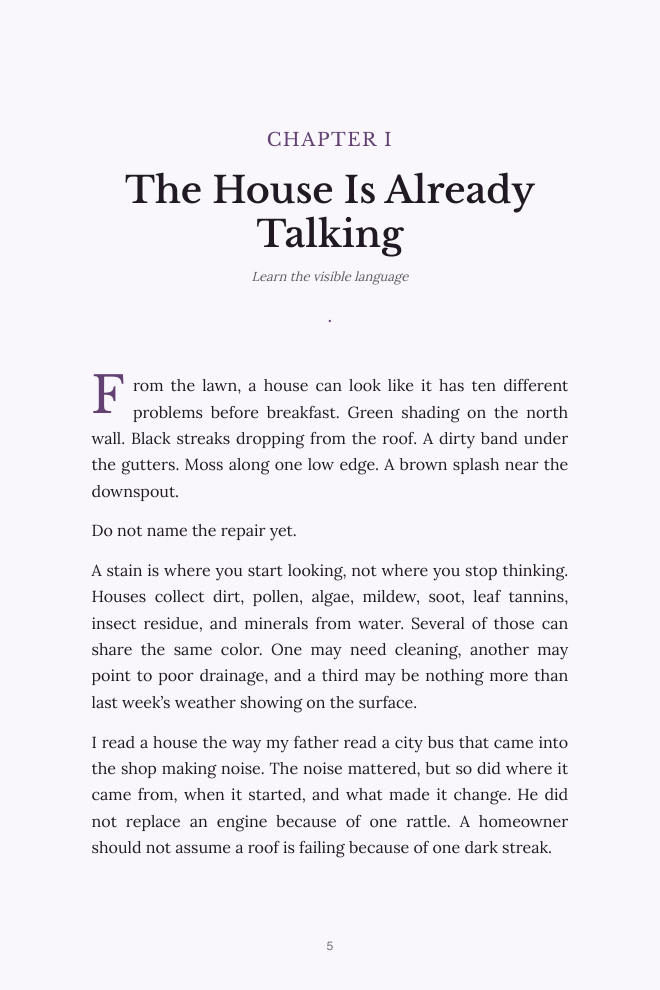
Page 5 — The House Is Already Talking
Page 5 — The House Is Already Talking ↗
Page 12 — Read the Roof Without Climbing
Page 12 — Read the Roof Without Climbing ↗
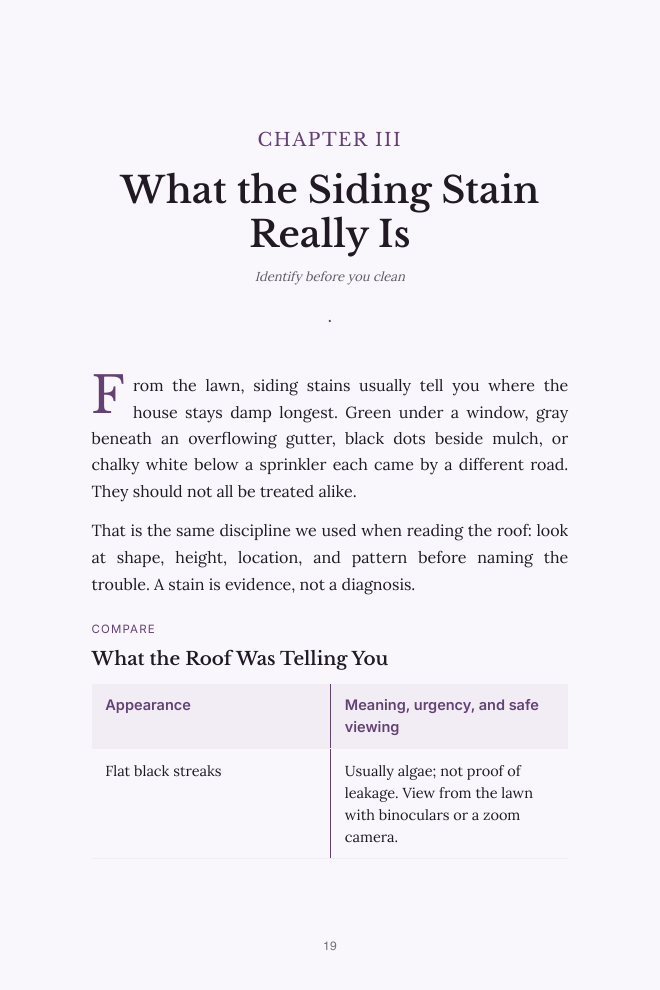
Page 19 — What the Siding Stain Really Is
Page 19 — What the Siding Stain Really Is ↗
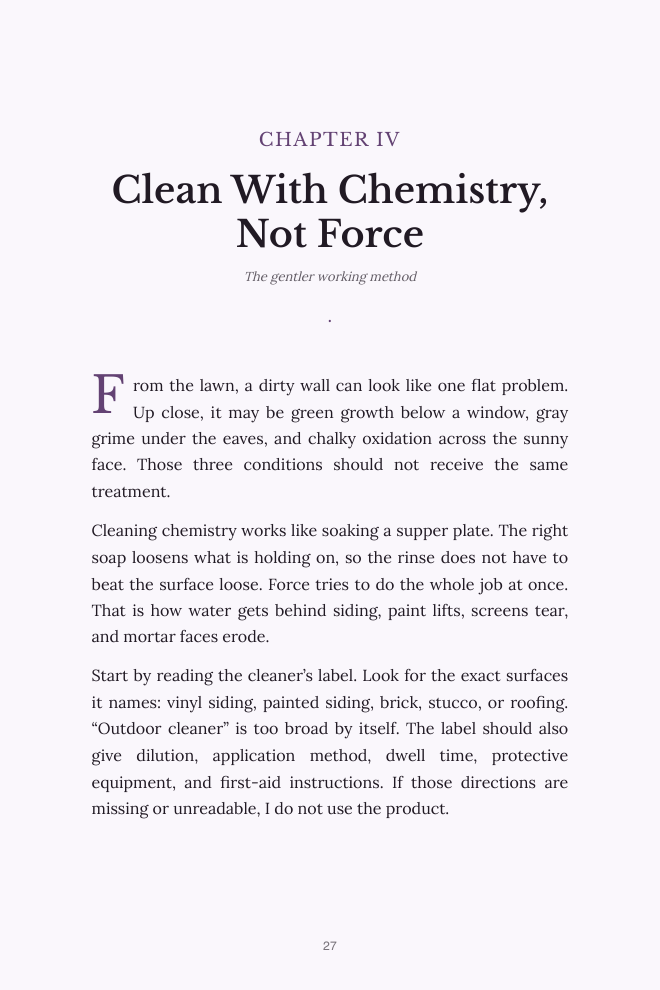
Page 27 — Clean With Chemistry, Not Force
Page 27 — Clean With Chemistry, Not Force ↗
Tyrus Rider

From the author

Why I start with both feet on the ground

I grew up in Dayton watching my father, Clifton, repair city buses. He taught me that a noise matters, but so do its location, timing, and pattern. When I was a boy, I also watched him mistake algae streaks for a failing roof. That memory stayed with me: an expensive conclusion can grow out of an ordinary mark.

I have worked around ladders throughout my working life, mostly washing vinyl and brick houses in older suburban neighborhoods. After holding my father's ladder during a fall that sprained his wrist, and later learning ground-level gutter work from a retired telephone lineman I call Mr. Odell, I became strict about unnecessary climbing. I no longer go onto roofs, and I will not send a homeowner up there. I would rather help you observe carefully, correct recurring moisture conditions, and call the right person when the evidence truly points beyond cleaning.

— Tyrus Rider

This is for you if

Who I wrote this for

This is for you if

  • You own or care for a house with vinyl, brick, roof streaks, gutter overflow, moss, or recurring exterior buildup.
  • You want a careful first read based on visible patterns rather than a dramatic diagnosis from color alone.
  • You are willing to walk a repeatable route, take dated photographs, compare conditions after rain, and follow product labels.
  • You prefer low-force cleaning, plant protection, and firm boundaries around ladders, roofs, chemicals, and electrical fixtures.

What you get

One practical handbook for the full exterior walk

Your order includes Read Your House From the Ground as a 66-page PDF edition. It contains 8 chapters, one ground-level inspection method, one comparison table, and one seasonal checklist covering roofs, siding, gutters, masonry, drainage, vegetation, and photo records.

Read Your House From the Ground

Your order

Read Your House From the Ground

$19

66-page PDF edition

66 pages · 8 chapters · 1 seasonal checklist

  • Read Your House From the Ground · 65 · PDF
Get the PDF $19

7-day money-back guarantee

What you can work toward

What you can work toward

AI-generated illustrations of potential readers.

Describe a roof mark without guessing

Use slope orientation, shade, dew, metal runoff, texture, and ground-level photographs to distinguish flat streaking from raised growth or visible physical damage.

AI-generated illustrations of potential readers.

Stop washing the same green wall

Look beyond the surface for shrubs, sprinkler overspray, gutter overflow, splashback, shade, and weak airflow. Correct the damp condition, then clean and monitor.

AI-generated illustrations of potential readers.

Follow overflow to its source

Track rain through the gutter outlet, downspout, extension, and discharge area. The book helps you turn a vague drainage complaint into a specific observation.

AI-generated illustrations of potential readers.

Ground-Level House Notes

Questions

How is the book organized?

Eight chapters. It starts with reading the house from the ground, then covers roof streaks, siding stains, cleaning with chemistry instead of force, following water through the gutters, brick and mortar marks, why the same wall keeps getting dirty, and a year-round checklist.

Do I need exterior-cleaning experience to use the book?

No prior trade experience is assumed. The book starts with ordinary observations you can make from firm ground: where a mark begins, whether it lies flat or appears raised, what sits above it, how water travels, and whether the condition changes after rain or over time.

Does the book explain black roof streaks and moss?

Yes. It compares flat algae-like streaking, raised moss, missing granules, lifted shingles, and flashing defects by appearance, likely meaning, urgency, and safe viewing method. It also explains shade, slope orientation, dew, and the clean strips sometimes seen below metal.

Will it help me identify green or spotted marks on vinyl siding?

Yes. The siding chapter separates algae, mildew-like growth, ordinary grime, oxidation, artillery fungus, rust, and irrigation deposits. It also asks why the surface stays damp, including vegetation, airflow, runoff, shade, and sprinkler overspray.

Does it recommend pressure washing?

The cleaning approach favors suitable labeled exterior cleaners, hidden-area testing, controlled dwell time, plant protection, and low-force rinsing. It stresses that stronger pressure is not automatically better, oxidation is not ordinary dirt, and cleaners should never be mixed into improvised combinations.

Does the gutter chapter require climbing a ladder?

The chapter follows water from the roof surface through the gutter, outlet, downspout, extension, and final discharge point. Tyrus uses a garden hose and telescoping wand for appropriate single-story gutter work from the ground, while height, guards, buried drains, damage, or unsafe conditions change the next decision.

What does the book cover about brick and mortar?

It explains visible differences among surface growth, splashback, mineral deposits, rust staining, mortar deterioration, cracking, and persistent moisture. The emphasis is on identifying the pattern carefully and recognizing when washing is not the appropriate answer.

What file format is included?

The book is supplied as a PDF edition. It contains 66 pages and 8 chapters.

Is there a guarantee?

Yes, a 7-day money-back guarantee. Questions or a refund? Just reply to the purchase email you got from Hotmart. A real person answers.


Look first. Name the work second.

Take the book outside, keep your feet on firm ground, and follow one mark from its visible edge toward its likely source. A careful description is often the best first tool you can bring to the house.

Get the PDF $19

PDF